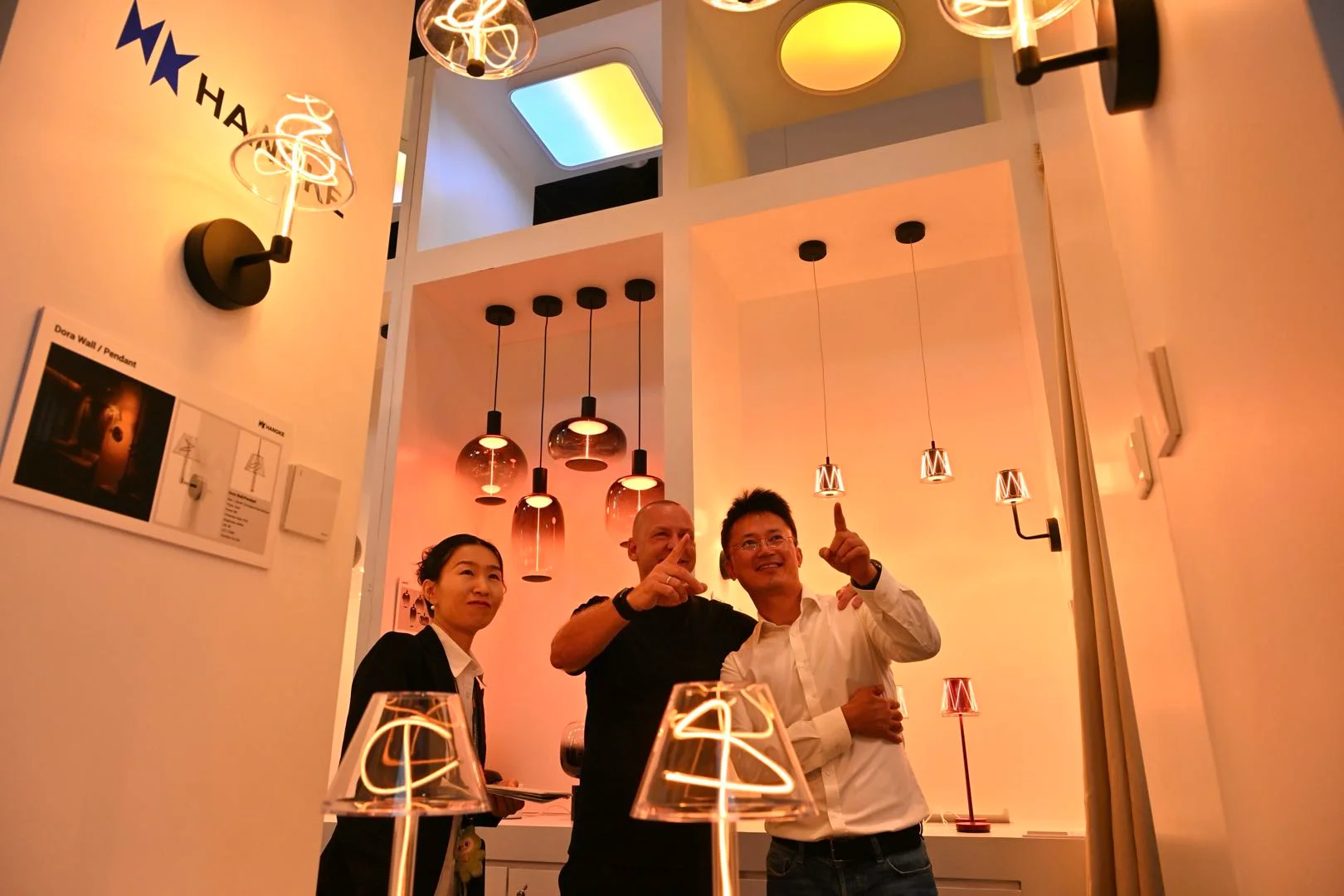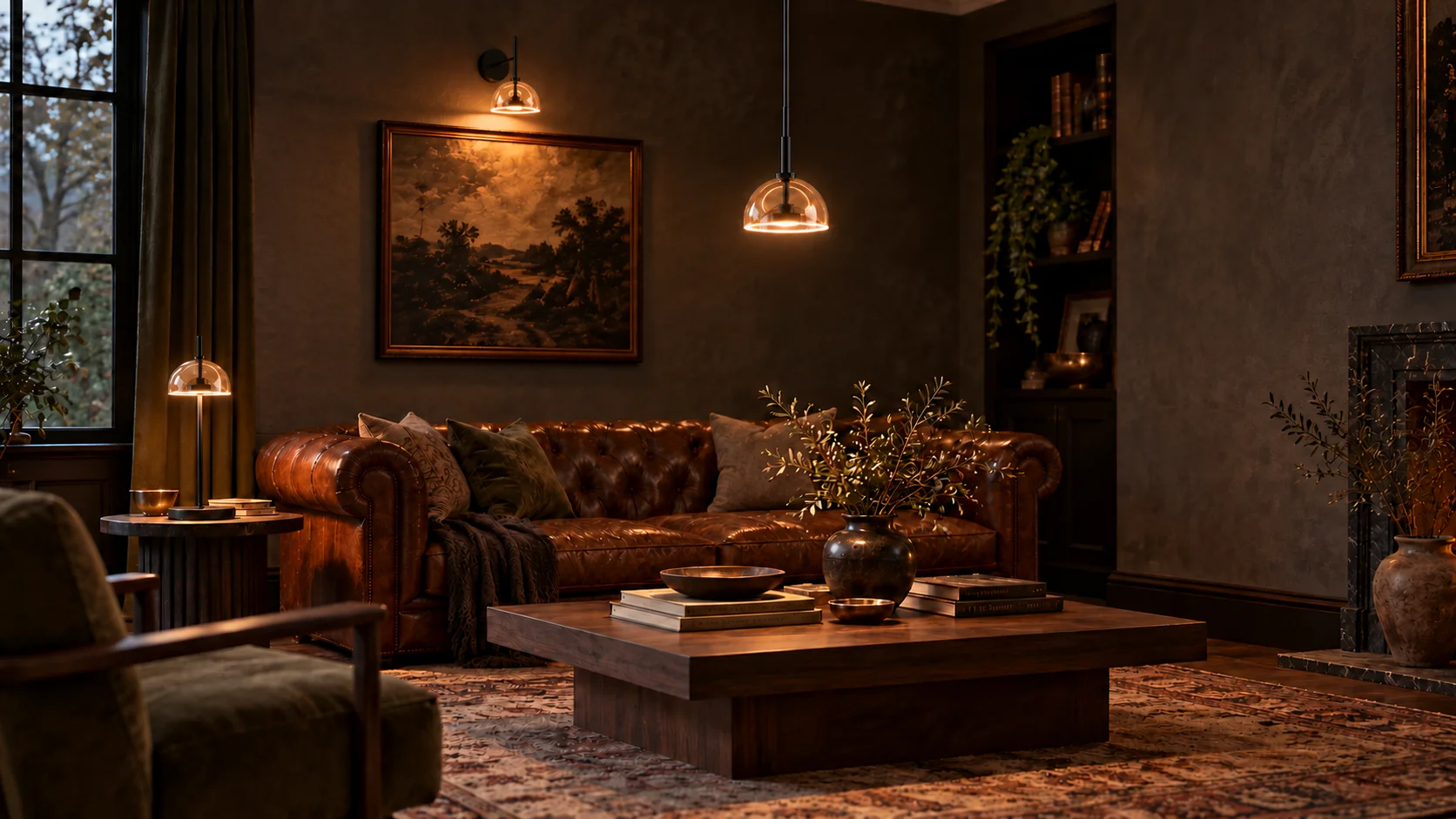
Layered Lighting: A Buying Guide for Retailers & Bulk Buyers
Walking through a well-merchandised lighting showroom in 2026, one thing stands out: almost no room…

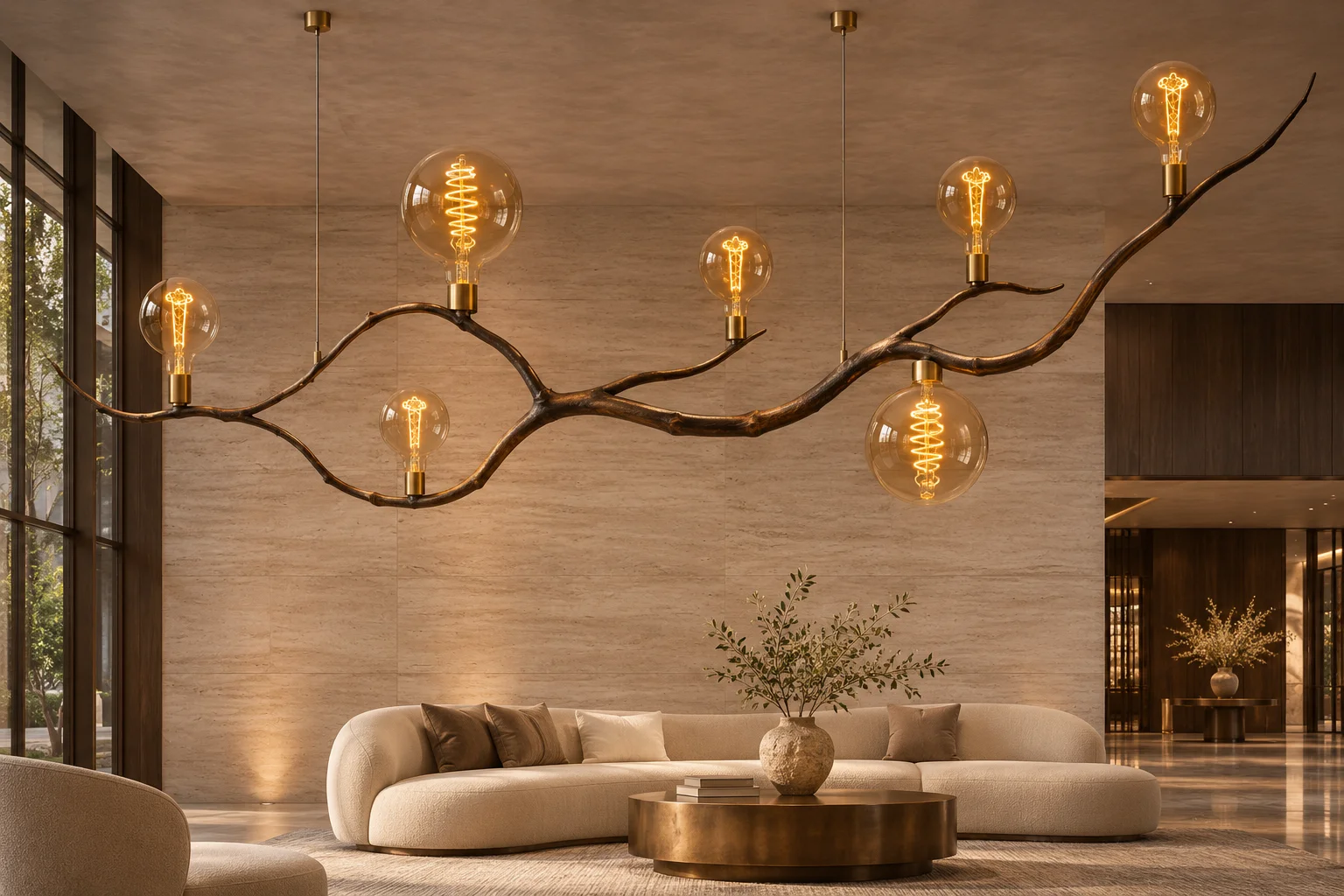
A sculptural chandelier can look balanced in a drawing and surprisingly crowded once the bulbs are installed. A clear-glass pendant can reveal a filament that competes with the shade. In both cases, a small component changes the whole design.
Choosing LED filament bulbs for mid-century modern fixtures starts with the role of the visible light source. Match the bulb’s size and filament pattern to the fixture, then check light output, dimming, electrical requirements and replacement needs in the intended setting. For multi-lamp designs, evaluate the complete arrangement before approving a bulb.
For lighting brands, retail buyers and commercial designers, this is a chance to make the finished product more recognisable. The mid-century modern vocabulary keeps the light source on show — open frames, tapered arms, brass and walnut, glass globes held away from the ceiling — so the bulb reads as part of the design language rather than a hidden consumable. At Hangke, our work spans decorative fixtures and LED filament bulbs, so the relationship between the two is central to how we approach a lighting brief. For the fixture side of the decision, see our guide to choosing mid-century lighting.
In a minimal open pendant, the bulb may be the main visual feature. In a branching chandelier, it becomes one repeated element within a larger composition. Behind textured glass, the visible filament may matter less than the illuminated effect.
These situations call for different choices. A pronounced spiral can bring detail to a simple fixture. A restrained linear filament may better support a structure with several arms or intersecting lines. Neither is automatically the better option; judge it against the fixture around it.
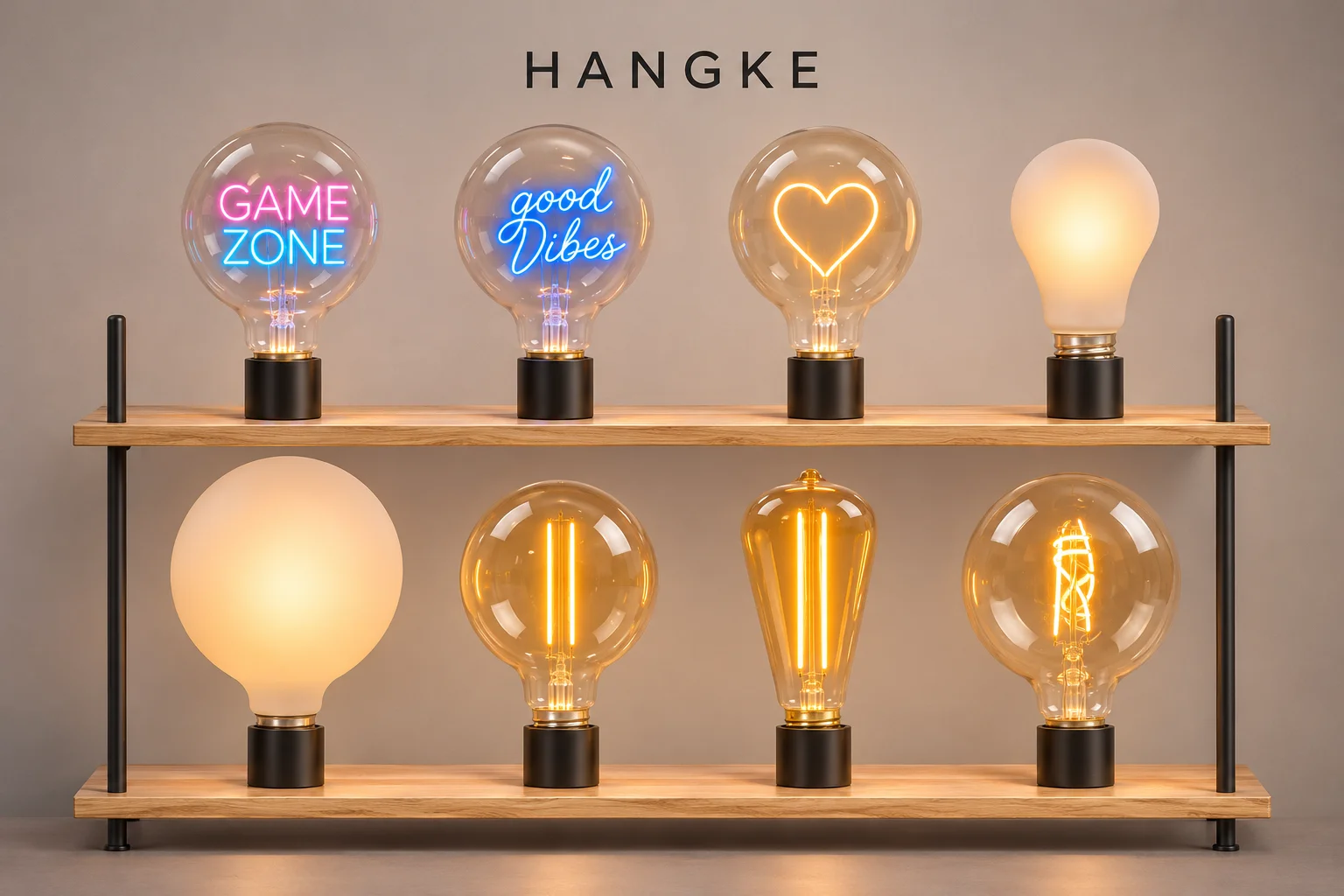
Hangke’s Gold Spiral Filament Bulb offers a fine spiral within A60, ST64 and G95 profiles. It gives buyers a starting point for comparing the same filament approach across different glass shapes.
The Minimalist Magnetic Bulb explores another direction, with a magnetic filament structure that can form a vertical line or curved arc. Inside a later mid-century or contemporary frame, that changes the visual vocabulary available beyond a conventional Edison-style coil.
These are design options to evaluate in samples. Their suitability still depends on the selected model and fixture.
A large fixture does not always need large bulbs. Several compact sources can preserve the open space within a sculptural frame, while oversized globes may become its dominant feature.
Check the bulb’s diameter and overall length against the socket position, shade opening and surrounding structure. Include the portion of the neck that remains visible after installation. A bulb that fits mechanically can still sit too low or project awkwardly beyond the shade.
For a cluster pendant, review the composition from below as well as from across the room. For a wall light, inspect the side view. For a table lamp, check it from a seated position.
The useful approval image shows the actual bulb installed in the actual fixture. A separate bulb photograph cannot establish that relationship.
For a broader introduction to bulb styles and finishes, see our decorative light bulbs guide.
One decorative bulb and twelve decorative bulbs make different demands on a space.
A filament pattern that looks delicate on its own may become visually dense when repeated. Glass tint can also read differently across a cluster. Differences in filament position or light colour become easier to notice when lamps are viewed side by side. In a sputnik or sunburst composition the sources are the form, so any variation between them is read as a design decision rather than a batch detail.
Before confirming the specification, assemble a representative group at the intended spacing. Review it switched off, at full output and at the planned operating level if dimming is required. Look from the positions people will actually occupy, including seats beneath or beside the fixture.
Consider combined light output as well as appearance. Twelve bulbs rated at 350 lumens have a combined nominal output of 4,200 lumens before fixture losses. That calculation does not establish table illuminance or visual comfort; the fixture, layout and room still need assessment.
For repeat production, approve reference samples and agree acceptable tolerances for visible features. Record the filament arrangement, glass finish and light-colour specification so future orders have a defined comparison point.
Vintage appearance can work in a modern restaurant, hotel lounge or retail interior. The operating requirements come from the application, not the style label.
| Setting | What to assess | What to confirm before ordering |
|---|---|---|
| Restaurant or café | Direct views of the source from seated positions; interaction with dining light | Required lumen output, colour rendering and tested dimming behaviour |
| Hotel lobby or lounge | Appearance across several fixtures; access for maintenance | Approved model, consistent appearance and replacement plan |
| Boutique retail | Relationship between decorative light and merchandise lighting | Colour quality and whether separate display lighting is needed |
| Large sculptural installation | Repetition, spacing, combined output and viewing angles | A representative assembly and the complete electrical and control specification |
An atmospheric decorative bulb may need separate task or display lighting alongside it. A warm colour temperature also does not guarantee low glare: assess the exposed source at the actual viewing distance and output level.
Do not approve a product family on the assumption that every model shares the same functions.
Hangke’s Gold Spiral Filament Bulb, for example, is a non-dimmable model. Where dimming is part of the lighting design — a restaurant, a hotel lounge, a residential scheme with scene control — that has to be established at the shortlist stage, not after the installation is signed off. The reverse matters too: on a project running simple switched circuits, a non-dimmable filament bulb removes a control component the design never needed.
Where dimming is required, state it in the brief: rated voltage, cap, dimming method (trailing-edge, leading-edge or DALI where applicable), and the control equipment the project will actually use. Then ask for a dimming test report on the exact model, rather than a “dimmable” claim carried across a range. Check low-level operation, start-up behaviour and any flicker or audible noise against that equipment.
Market versions can also differ in rated voltage and cap, so confirm the exact version for each destination. Finally, check enclosed-fixture suitability and any other installation restriction listed for the selected model.
In a visible-source fixture, a replacement bulb changes the appearance as well as restoring light.
For commercial projects, keep a record of the approved SKU, dimensions, glass finish, filament layout, electrical ratings and control requirements. Agree a practical spare-stock plan with the buyer and discuss how future substitutions will be reviewed.
This matters for retail collections too. If a fixture is photographed and displayed with a distinctive bulb, make that pairing clear in the product information. State whether the bulb is included and identify the intended replacement specification.
For a longer view of how the vintage and mid-century category is being specified, our mid-century modern lighting guide covers the fixture side in more detail.
Hangke’s filament development and decorative lighting work give brands a way to discuss the visible source alongside the fixture concept. Our OEM/ODM approach connects design support, prototyping and production planning.
An effective first brief can be short. Send a fixture drawing or reference image, bulb clearances, the intended number of lamps, target market and application. Add the desired glass and filament appearance, required light output, control needs and expected order scope.
From there, existing designs can be shortlisted and development options discussed against the brief. Confirm performance and market documentation for the exact model before approval.
Browse our LED filament bulb collection to compare design directions. Filament bulb programmes start at 1,000 pieces, with stock shapes sampled in 3–5 working days and a new shape or finish around 15 days for tooling and sample approval.
Yes, where the fixture accepts a compatible replaceable bulb. Check dimensions, cap, voltage and permitted lamp ratings, then assess whether the filament and glass complement the design. Integrated LED fixtures do not necessarily accept replacement bulbs.
Choose according to the bulb’s role in the complete composition. Compare shape, filament detail, spacing and combined output in a representative assembly. There is no single bulb shape that suits every sculptural fixture.
No. Dimming depends on the exact model, market version and control equipment. A vintage appearance, screw cap or warm colour temperature does not establish dimming compatibility.
Approve a reference sample and a representative group at the intended spacing, then record filament arrangement, glass finish and light-colour specification. That record, not a photograph, becomes the comparison point for future orders.
Developing a mid-century modern fixture or a commercial lighting collection? Send your fixture concept to Hangke and request suitable filament bulb options for evaluation.