Custom Lighting Design for Private-Label Brands: An OEM/ODM Playbook
Most private-label lighting programs don’t fail at manufacturing. They fail at the hand-off — when…


A hotel room lamp leads a harder life than any lamp in a home. It gets switched on and off dozens of times a day, nudged across the nightstand by guests who never notice, wiped down with strong cleaners between stays, and left burning for hours in an empty room. Most hotel lamps on the market were designed for living rooms, then sold to hotels because the price fit the budget. The gap shows up later — as dead units, mismatched shades across floors, and maintenance tickets that quietly eat the housekeeping schedule.
The failure modes are predictable. A base too light for its shade tips over the first time a guest’s laptop bag lands on the nightstand. A touch dimmer calibrated for gentle home use starts misreading after ten thousand cycles. Finishes that look fine in a showroom dull under the alcohol-based cleaners housekeeping actually uses. None of these are exotic defects — they are ordinary parts asked to do hotel work. A hotel lamp should be specified for cycle life, wipe-down chemistry and tip resistance first, and styled second. When buyers reverse that order, they usually buy the same lamp twice: once for the photo shoot, once for the store room.
The details that decide whether a hotel lamp earns its place rarely appear in a render. Weight and footprint keep the lamp upright on a narrow nightstand shared by two guests. The switch position decides whether a half-awake guest can find it without turning on the ceiling light. Warm dimming behaviour matters more than maximum brightness — a lamp that jumps from dim to harsh reads as broken. And colour temperature held within a tight batch window (we hold CCT within ±100K) is what keeps room 214 looking identical to room 812. Guests never notice when it’s right. They notice immediately when one floor runs warmer than the next.
Hotels are commercial buildings, and commercial buildings have inspectors. For North America that means UL or ETL on the fixture and a 120V/E26 electrical build; for Europe, CE with 220–240V/E27. This is also where a factory’s depth shows: a North American version (120V/E26/UL/FCC) is a product-line capability you build into the range, not a special favour per order. Buyers who source residential-certified stock to save a little usually discover the gap at the worst moment — during a fitting-out inspection, with furniture already installed. Certification belongs in the first spec, not the last email.
Hotels don’t buy lamps; they buy repeatability. The unit installed during fit-out is the same unit that will be reordered in year three when a wing is refreshed — and if the reorder drifts in shade colour, finish or glow, the corridors start looking mismatched. That is why a serious hotel-lamp program is built on batch consistency and a spares plan: replaceable modules where the regulation allows it, and a documented parts list so engineering can reorder a shade, a base or a driver without reverse-engineering anything. A lamp with no spares path is a future maintenance contract you didn’t price.
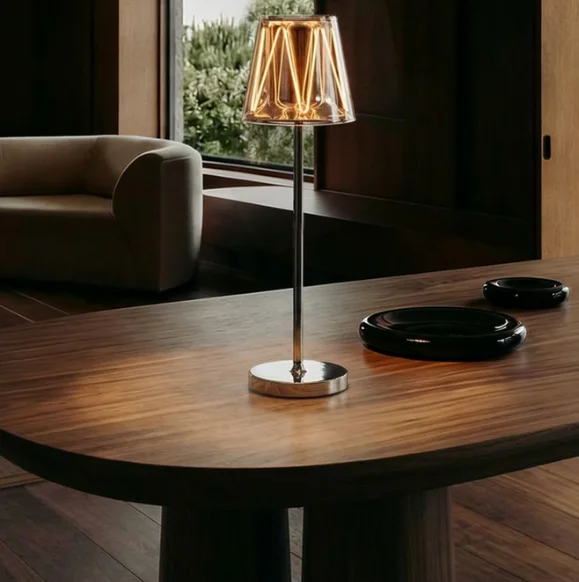
The newest shift in hotel lamps is the removal of the cord. A cordless table lamp frees the nightstand from outlet geography, survives the cleaning trolley better, and lets housekeeping restyle a room in seconds. It also moves part of the spec from the lamp to the charging habit — dock placement, battery life through a full service day. We build cordless fixtures like the Cup Cake table lamp with exactly this balance in mind: light enough to move, stable enough to trust, chargeable between turn-downs. For procurement, the question is no longer whether cordless belongs in a guest room, but which rooms get it first.
Hotel lamp programs scale in stages, and the factory floor should match that. For decorative fixtures we typically quote 300–500 pieces for a full program and can open a trial run at around 100 pieces — enough to dress a pilot floor, put the lamps through real housekeeping, and see how guests treat them before committing to the whole property. A supplier who pushes a blended container minimum is asking the hotel to learn from the entire building at once. Learn from one floor instead.
The best hotel lighting outcomes we see start with a procurement team that specifies behaviour — cycle life, finish chemistry, batch consistency, certification targets — and lets the factory respond with structure. Our decorative lighting line and wholesale program are built for exactly this conversation, and our ODM team works from drawings, reference samples or a plain written brief. If a hotel refresh or a new property is on your calendar, send us the spec — the earlier engineering sees it, the fewer rooms it costs you to get right.