

Hong Kong International Lighting Fair 2026: Buyer’s Guide
Dates, zones and a preparation checklist for retail, wholesale and brand buyers — plus where…
Most guides to filament light bulbs read like a parts catalogue. This one is written from the factory floor, where the differences between bulb types show up long before they reach a showroom — in yields, in failure points, and in the questions buyers should be asking.
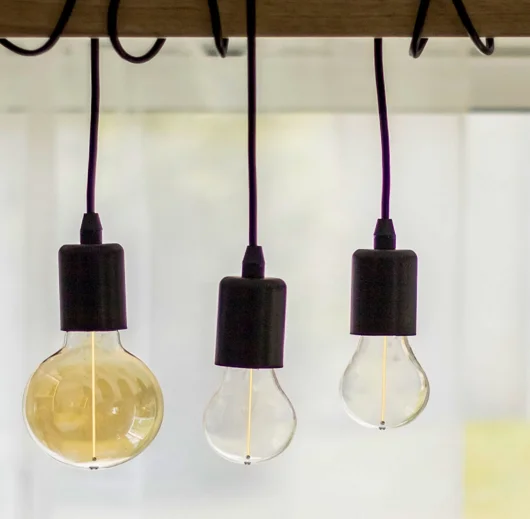
A filament bulb places LED chips on narrow strips — the “filaments” — inside a glass envelope, so the light source itself looks like the tungsten wire it replaced. The filaments emit across nearly a full circle, unlike SMD boards that sit behind a diffuser.
The factory view: in most lighting categories the bulb is a hidden component. In decorative filament programmes, the bulb is the design object — fully visible, on and off. That changes what “quality” means: appearance lit and unlit, dimming behaviour on the customer’s wall dimmer, glass consistency unit to unit. Buyers who evaluate visible bulbs by lumens per dollar alone are the ones who end up processing returns.
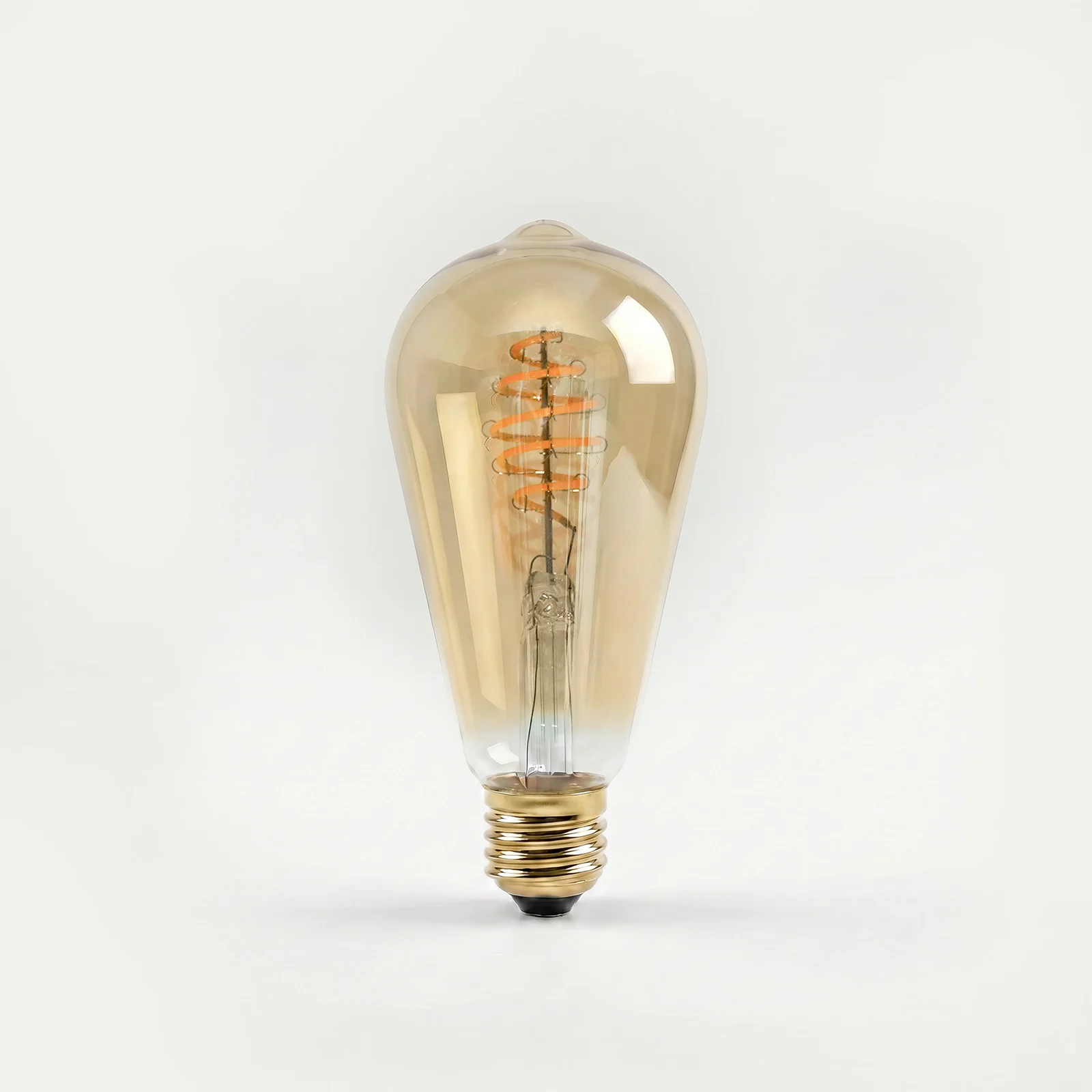
The catalogue names look simple — straight (I), spiral (S), and flexible curves formed into W, M, 7, U or hook arrangements — but each step up in geometry is a step up in handling:
Why this matters to your unit cost: yield drops as geometry gets more ambitious — every bend is additional handling before the glass is sealed. At the thin end, ultra-fine flexible filaments around 0.6 mm (versus roughly 1.5 mm conventional) are not simply “thinner”: they require flip-chip packaging on a flexible film rather than a rigid board — a genuine barrier to entry. So ask any supplier how their flexible filament is packaged, not just how thin it is.
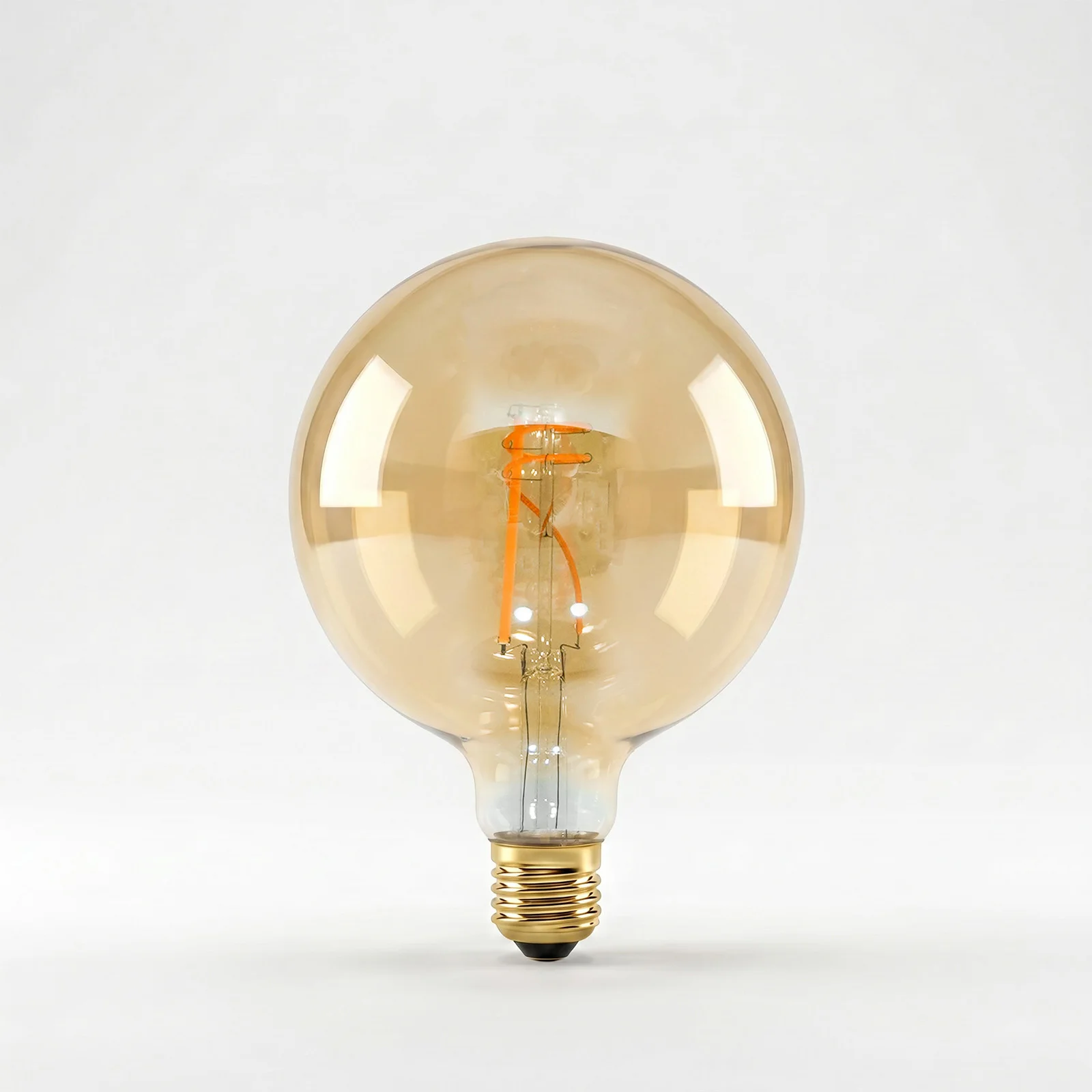
The envelope families are familiar: A-shape (A60, the metric twin of the North American A19), the ST64 teardrop, G80/G95/G125 globes, C35/B35 candles, P45 rounds and T-tubulars. One cross-market note: A60 and A19 describe the same 60 mm envelope — keep regional naming consistent in your product data.
Finishes change both the look and the light: clear glass shows the filament at full contrast; milky or frosted glass diffuses and hides the wire when a fixture needs glow without the show; white filaments on clear glass give the filament look a cleaner, contemporary read.
The pairing rule most catalogues ignore: finish and colour temperature should be chosen together, not independently. In practice, amber glass is paired with 2200K filaments and smoky glass with 1800K — the glass and the light source warm each other. Stack amber glass on top of an already very warm filament and the result reads visibly warmer than either spec sheet suggests. One more on/off detail worth checking: tinted filaments can look different unlit, while white filaments on clear glass keep the same appearance whether the switch is on or off.
Not every line on a spec sheet deserves the same attention:
A filament bulb concentrates its risk in a few places: the joints where filaments meet the stem, the stem assembly itself, and the driver electronics — flicker and buzz almost always trace back to the driver, not the filament. Flicker-free operation over tens of thousands of hours is a driver and process question, not a marketing line.
The supply-chain question worth asking: which of these components does the supplier actually manufacture? Factories that produce the filament, stem, bulb shell and driver in-house control the interfaces where failures start. Factories that trade parts in do not. Verification capacity is a reasonable proxy for process openness: witness testing under SGS and TÜV supervision is the level of transparency to expect from a serious manufacturing partner.
The same bulb ships in two different worlds. European versions run on 220–240 V with E27 or E14 bases and carry CE; North American versions run on 120 V with E26 or E12 bases and carry UL and FCC. Voltage, driver design and certification all follow the target market — this is not a sticker change. Our IS Spiral Filament Bulb as shipped:
| EU version | NA version | |
|---|---|---|
| Voltage | 220–240 V | 120 V |
| Base | E27 | E26 |
| Output | 806 lm | 800 lm |
| Power / CCT / CRI | 8.8 W · 2200 K · 80 | 8.8 W · 2200 K · 80 |
| Certification | CE | UL / FCC |
The check most buyers skip is intellectual property. Signature filament designs — from classic bulb structures to spiral and ultra-fine flexible filaments — sit on granted patents and registered trademarks, and licensing arrangements exist between manufacturers. In the EU and US, IP exposure lands on the importer and the brand, not only the factory that ran the production run. For any distinctive filament design, ask for the patent or licensing documentation before you place the order.
On programme logistics: filament bulb programmes typically start at 1,000 pieces, with samples in 3–5 working days and mass production 30–40 days after sample approval.
Hangke manufactures LED filament bulbs end to end — filament, stem, bulb shell and driver — in EU and North American configurations, and holds the patents behind its flexible filament technology. For a structured way to compare suppliers, start with our 7-point OEM manufacturer evaluation checklist, or talk to our team about your project.
Every shape in this guide is available as an OEM or private-label programme.
Working on a filament bulb range? Send your spec to our team.